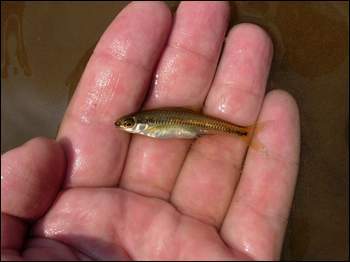
"The Cape Fear Shiner is a yellowish minnow with black stripes, pointed fins and a hard-luck past.”
So writes Taft Wireback for the News-Record of Greensboro, North Carolina. He goes on to tell how bringing down a dam helped bring back two "relict populations" of this small fish.
It’s a wonderful lede, and an inspiring story, especially for those of us hoping to bring back the signature piscine species of Southern California, the steelback, which is widely believed to be able to rebound, if only given the opportunity.
Wireback writes:
You can think of the tiny yellow-and-black minnow as a sort of
miner’s canary that swims, a bellwether for the health and restored
vigor of the water that surrounds it.
The tiny minnow was unknown
to science until 1971, when it was identified in a very limited range
that included small reaches of the Haw and Deep rivers in just five
counties — Randolph, Chatham, Lee, Moore and Harnett.
By September 1987, it already had been placed on the federal Endangered Species List because of its dwindling habitat.
The minnows need water of decent quality riffling in shallow depths over gravel, stone and boulder bottoms.
The
dam that was demolished was a small, hydroelectric operation built in
1921 and shut down in June 2004. But the site, near the line between
Chatham and Lee counties, had hosted a series of dams stretching back
into the 19th century.
So biologists couldn’t be sure how long
two separate colonies of Cape Fear Shiner had been separated by one dam
or another and its 10-mile stretch of backed-up water, too deep and
slow for the minnow’s liking.
Meanwhile, on either side of the
dam, the isolated populations of Cape Fear Shiner were dwindling.
Removing the dam produced results aimed at fixing that problem faster
than anyone had been willing to hope, [Adam] Riggsbee, [environmental scientist] said.
"If you
provide the habitat, the theory is that you should get the species back
in place," he said. "That’s exactly what has happened here in less than
two years. The river responded very quickly and so did this key
species."
(h/t: Knight Science Journalism Tracker)
 Kit Stolz
Very informative article and good news as well for this small fish. Thank you so much for sharing!
LikeLike