I’m not a big fan of David Brooks, and think he’s far more of an ideologue and less of a free-thinker than he realizes, but when he’s right, he’s right. We as a nation have turned a corner.
For better or worse, a new era awaits us: Progressive Capitalism
Over the next few years, the U.S. will have to climb out from under
mountainous piles of debt. Many predict a long, gray recession. The
country will not turn to free-market supply-siders. Nor will it turn to
left-wing populists. It will turn to the safe heads from the investment
banks. For Republicans, people like Paulson. For Democrats, the guiding
lights will be those establishment figures who advised Barack Obama
last week — including Volcker, Robert Rubin and Warren Buffett.These time-tested advisers, or more precisely, their acolytes, are
going to make the health and survival of the financial markets their
first order of business, because without that stability, the entire
economy will be in danger. Beyond that, they will embrace a certain
sort of governing approach.The government will be much more
active in economic management (pleasing a certain sort of establishment
Democrat). Government activism will provide support to corporations,
banks and business and will be used to shore up the stable conditions
they need to thrive (pleasing a certain sort of establishment
Republican). Tax revenues from business activities will pay for
progressive but business-friendly causes — investments in green
technology, health care reform, infrastructure spending, education
reform and scientific research.If you wanted to devise a name
for this approach, you might pick the phrase economist Arnold Kling has
used: Progressive Corporatism. We’re not entering a phase in which
government stands back and lets the chips fall. We’re not entering an
era when the government pounds the powerful on behalf of the people.
We’re entering an era of the educated establishment, in which
government acts to create a stable — and often oligarchic — framework
for capitalist endeavor.After a liberal era and then a conservative era, we’re getting a glimpse of what comes next.
Another example: the Los Angeles Times reports today (see here) that massive changes, staff cuts, and risk reduction is expected on the Street.
Last week’s bankruptcy filing of Lehman Bros. Holdings Inc. and
shotgun engagement of Merrill Lynch & Co. to Bank of America Corp.
— after the demise of Bear Stearns Cos. in March — signal the most
dramatic reordering of Wall Street since the Great Depression.Even if the huge government intervention announced late last week
succeeds in stemming the current crisis, Wall Street’s basic business
model will be revamped, many in the business say, with its earnings,
workforce and appetite for risk greatly reduced and its swashbuckling
ethos ratcheted back.The new era of subdued expectations is likely to affect not only
traditional investment banks but also hedge funds and private equity
firms, which gained high profiles in recent years.
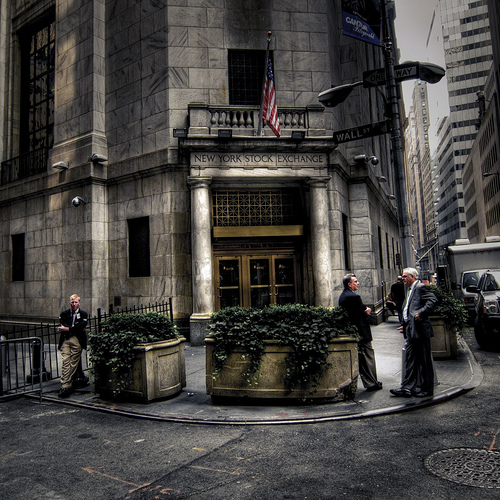
[pic courtesy of Brian T. Murphy, who took it for his brother, who works on the Street]
 Kit Stolz
Obviously, we do not all agree on the terms progressive or capitalism.
Progressivism is for some of us the movement by T. Roosevelt toward democracy, ie., national referendums, recalls, initiatives, and popular vote.
Capitalism for some of us is the true ownership of private property rather than renting it with property taxes or having its use regulated.
http://theprogressivecapitalist.blogspot.com/
LikeLike